On How To Kill The Divine: A JRPG Guide To Deicide
Trust me, it's not what you think it is
Written by Karthik Ramanathan(https://axisspri.me) for the Japanese Club of VIT Chennai, syndicated to my personal blog
Warning: This post contains spoilers for the Shin Megami Tensei and Persona series. You have been warned.
The irony is divine.
You start a JRPG looking for a farmer's lost chicken. You beat up some slimes in a field. You depose a corrupt noble. You topple an empire. And then, through some absurd escalation of scope that would make most media feel underwhelming, you're throwing hands with His Holiness, Supreme Creator of the Universe.
Mention Shin Megami Tensei, Persona, or half of Final Fantasy, and someone drops the same line.
"Average JRPG moment."
And to be completely fair to them, it is funny.
But the funny part isn't the whole story. The real question isn't why the joke exists. It's how an entire pop culture built an efficient pipeline where turning God into a turn-based boss fight felt like the only logical place for a story to meet its end. Not a shocking place. Not a blasphemous place. The logical one.
To answer that, you can't really start with the games. You have to start a few thousand years earlier, with a country that quietly never agreed to the terms everyone else operated on.
For Divinity Was Always Within Your Reach Here
Here's the thing most people get wrong when they try to explain this. They say "Shinto has lots of gods" and think that's the entire explanation.
It's true, but it's too small, and it misses why it matters.
Shinto, Japan's indigenous tradition, is built around kami — divinities, spirits, and forces tied to specific things. A waterfall. A particular mountain. A storm. An old tree. A revered ancestor. The kami aren't one omnipotent Creator sitting outside the universe, watching everything and keeping a ledger. They're inside the world, woven through it. They can bless you or curse you. They can be honored, offended, petitioned, or forgotten. They are enormously powerful, and yet they are not automatically perfect, not automatically moral, and absolutely not untouchable.
This allows for a very different relationship between humanity and divinity than the one most of the world has been taught to expect.
If a god can be local, if it can be fallible, if it can be wrong or simply having a bad millennium, then standing against that god isn't automatically sacrilege. It's a disagreement. It's drama. It's conflict.
Some would go as far as calling it a boss fight.
And this is represented all the way in the mythology. Susano-o, the storm god, is a brat. He throws tantrums, wrecks his sister Amaterasu's rice fields, flings a flayed horse through her roof, and gets himself exiled from heaven by the other gods for being insufferable. Then he wanders down to earth, sobers up, slays an eight-headed serpent(Yamata-no-Orochi:八岐大蛇), and becomes a hero. That's not a distant, perfect deity. That's a character. With flaws. With a proper redemption story to boot.

So when a video game, centuries later, lets you recruit Susano-o, fuse him with another god, level him up, and send him into battle, its goal isn't to be edgy. It's being faithful. The culture had already decided, long ago, that divinity was a material you could work with. Not a wall you bowed down to.
Then a Different Kind of God Arrived in 1945
For a long time, that was the whole picture. Then, over centuries and in waves, another concept of "god" started arriving from outside and the most decisive wave came after 1945.
When the war ended, Japan was occupied by Allied forces under General MacArthur. Part of the reconstruction touched religion directly: in December 1945, the Shinto Directive disestablished State Shinto which was the nationalistic, state-managed version that had been harnessed to the war effort and separated it from government. Soon after, Emperor Hirohito publicly stepped back from the idea that he was a living divinity. (Historians still argue hard about how "free" the religious freedom that followed really was, and who it actually served but that's beyond the scope of this essay. I'm just interested in the video games, boss.)
The point for us is what came through that opened door, louder than before: the full Abrahamic conception of God. One Creator. Omnipotent. Omniscient. Good by definition rather than by behavior. A God who doesn't negotiate, can't be fused, and crucially, cannot be in the wrong, because being wrong isn't a move available to Him.
To a culture whose gods had always been negotiable, this was a genuinely different idea. But here's the part that matters, and the part that makes this a story about coexistence rather than conquest:
Japan didn't swap one god for the other. It absorbed the new one alongside the old ones.
This is a place that had already spent centuries layering Shinto and Buddhism on top of each other without ever demanding anyone pick a side. A country where, even now, a person might be blessed at a shrine as a baby, married in a chapel, and memorialized in a Buddhist funeral, and feel not the slightest contradiction. So the absolute, singular God didn't overwrite the pantheon. He got filed into it as another entry. Set on the shelf beside the kami, the buddhas, and the demons. Just another interesting and powerful entry in an already crowded catalogue.
And that is where things get quietly combustible, for once you place a god who claims to be the one true absolute onto a shelf full of gods you already know to be local and fallible, a question forms almost on its own:
What if The Absolute One is just... another entry? What if a being that insists it is perfect and infinite and good is, from a certain angle, simply a very powerful kami with an incredible PR team and a bigger throne?
Remember this question, for it is the seed of everything that follows.
For Nagai Made It Okay to Go Dark
A thought experiment needs a place to be played out loud. For that, the culture needed precedent to get uncomfortable. To go apocalyptic and religiously charged and genuinely nasty. And so precedent was set in 1972, from a manga artist named Go Nagai.

Devilman began, of all things, as an attempt at taming. Toei wanted to adapt Nagai's earlier, notorious Demon Lord Dante into a TV anime with a more marketable hero. What Nagai handed back instead was one of the most influential and most gut-wrenchingly cynical manga ever drawn. And he did something that turned out to be enormously important: he took the Abrahamic imagery that was still exotic and unfamiliar to most Japanese readers. Angels, demons, the literal Apocalypse, and he twisted it to something new.
In Devilman, the demons are real, and they are horrifying. Humanity is fragile and paranoid and cruel, turning on itself the instant fear takes hold. And the angels? They're cold. Alien. Utterly uncomforting. By the end, the heavenly host is arguably worse than anything from hell. The apocalypse isn't a future possibility. It's simply the setting of the manga.
You can draw a straight line from this one series to Neon Genesis Evangelion, to Berserk, to a huge slice of everything dark and religiously loaded in anime and manga since. Nagai built an entire audience that would not flinch when a story turned bleak, violent, sacred, and world-ending all at once. He made "the gods can be questioned, and maybe they've earned it" feel like a normal thing to put in a comic aimed at teenagers.
The table had been set by one of the most influential mangakas to exist. All they needed was a spark to light.
For A Man Saw the Spark in Silicon and Steel
That spark arrived in 1986, and it came from a novelist.
Aya Nishitani was simply an engineer at Toshiba, working in its online networks division. He apparently had a side hobby of being interested in the occult, and he was fascinated by the idea of summoning demons. That year, he published a science-fiction novel called Digital Devil Story: Megami Tensei. The plot, by today's standards, is almost quaint: a high-school programming genius in Tokyo writes software to summon a demon for revenge. and accidentally tears open a war between humans, gods, and demons.
But Nishitani's real stroke of genius wasn't the plot. It was a single metaphor sitting underneath it.

He looked at a computer. A blank, humming, digital box, lifeless and mysterious, and he saw a modern ritual circle. The terminal is the summoning grid. The code is the incantation. In his framework, a demon isn't a dusty relic out of a mythology textbook. It's data. Something that can be written, compiled, called into being, and bound. To him, technology wasn't the enemy of the occult. Technology was the new occult.
The idea that the ancient and mythic wired straight into the sleek and modern became a vessel. A vessel to contain three sections before it finally had somewhere to thrive. The confrontable gods of Shinto. The strange new absolute God on the shelf. Nagai's normalized darkness. All of it was in place, and Nishitani's novel was the match.
It just needed someone to read it, and then to make it a game.
Enter Atlus (Proudly Sponsored by Teenage Girls Taking Selfies since 1995)
(Author's note: I still don't know how to write this section without it sounding like a joke. I apologize in advance. I guess reality is stranger than fiction.)
In 1987, a tiny studio founded just one year earlier adapted Nishitani's novel into a game for the Famicom. That studio was Atlus. Namco published it. A sequel followed in 1989 on the same terms: Atlus builds, Namco publishes.
And this was all happening against a backdrop where video games, broadly, were still firmly high fantasy. Dragons. Chosen heroes. Crystals. Demon kings you stop before they conquer the kingdom. The medium had flashes of the divine sometimes. Dragon Quest II dropped a literal God of Destruction named Malroth on players back in 1987, but it hadn't figured out what it actually wanted to say about God yet. It was merely climbing an escalation ladder without a clear idea of what was waiting at the top.
Atlus had an idea. Mainly because they had read the book.
When they set out to make what was meant to be Megami Tensei III, they did something audacious: Atlus president Naoya Harano and designer Kouji Okada walked into the office of Namco's chairman and asked for permission to publish the game themselves. He agreed, reportedly on the strength of a personal friendship. So they retitled it Shin Megami Tensei, "shin" meaning "true" or "new"; cut the story ties to the earlier games, and rebuilt the whole thing on the Super Famicom. It released in 1992. Atlus published it. The franchise was, at last, entirely theirs.
And they knew exactly what they were building it against. Series artist Kazuma Kaneko, the man who designed most of these gods and demons, and whose fingerprints are on the whole aesthetic put it about as plainly as you can:
"I like to think of Shin Megami Tensei games as rock stars or singers in punk bands whereas blockbuster games like Final Fantasy are more like the Academy Award winners."
That posture matters, and we'll come back to it, because the rebellion isn't just in the plots. It's baked into the studio's entire idea of what a game is for.
And now for the single funniest sentence I will write this year:
The game studio that taught a generation how to kill God was quite substantially bankrolled by teenage girls taking selfies.
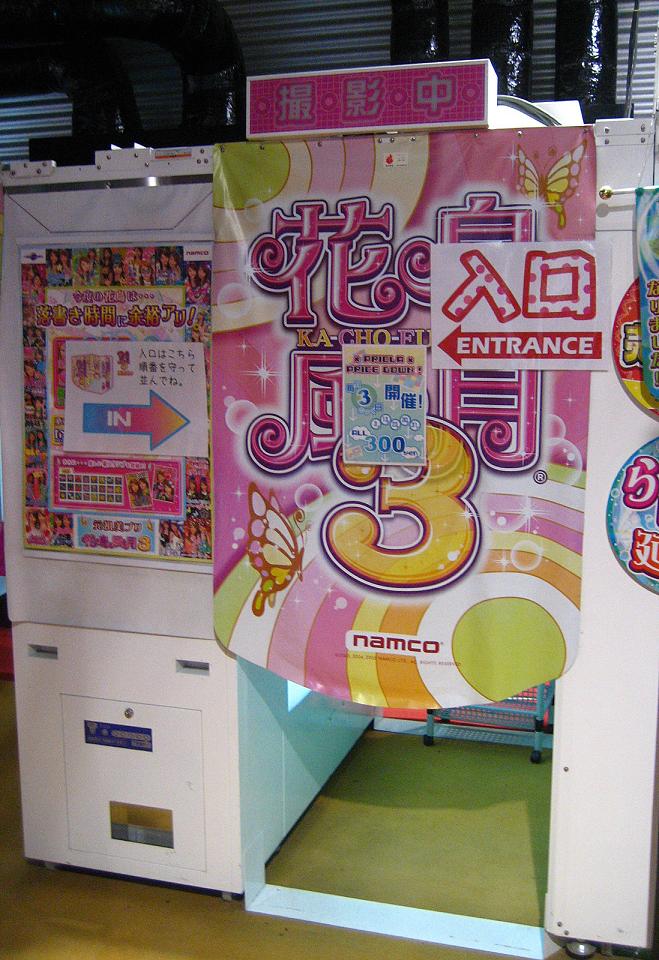
In 1994, an Atlus employee named Sasaki Miho pitched an idea for a photo-sticker booth. Her bosses were skeptical. They ran with it anyway, partnered with Sega, and in 1995 launched Print Club or purikura. It detonated. By 1996 it was the single highest-grossing arcade product in Japan; twenty thousand machines shipped nationwide; the craze got supercharged when the boy band SMAP started using them on TV. It became a genuine cultural institution, and it is the direct ancestor of every selfie filter you have ever used on Snapchat or Instagram.
Now, to be completely fair, these were just simultaneous events. Nobody at Atlus ever signed a memo reading "purikura profits shall fund the death of God." But the timeline does convey a story. While purikura was quietly minting money throughout the mid-to-late '90s, Atlus had the runway to keep making dense, strange, theologically fearless RPGs that were absolutely not guaranteed hits.
Revelations: Persona(or Megami Ibunroku Persona, sounds way cooler) arrived in 1996. It was the first high-school-set spinoff, and the very first game in the whole lineage to be localized for the West. The kami-negotiating, demon-fusing, God-questioning machine got to keep running, in no small part because a photo booth was footing the bill.
I still don't believe I have the privilege of telling people that teenagers taking selfies are the reason they can play a game where they punch God in the face. And yet...
Oh, They Actually Do Kill God By The Way
This is the good part, because Atlus doesn't kill God one way. They kill him a dozen ways — and the method is always the argument. The way you're made to do it is the point the game makes every. single. time.
The mainline SMT games: the poison is the doubt
The purest form is the numbered Shin Megami Tensei series. And its masterstroke isn't the act of deicide itself. It's the doubt it poisons you with on the way there. Nearly every SMT hands you an alignment choice, usually some flavor of:
- Law: absolute peace, all suffering ended, a perfect ordered world. Bought by erasing free will completely.
- Chaos: absolute freedom, strength, and self-determination. Bought with pure social Darwinism, the weak devoured by the strong.
- Neutral: human autonomy and the right to choose, even if it leaves you standing alone in the rubble.
The clincher, the thing that makes SMT, SMT — is that apocalypse and utopia sit on the exact same slider. What looks like salvation from one angle is tyranny from another. Heaven is a cage. Freedom is a slaughterhouse. The peaceful ending has a body count, and the bodies are everyone's self. Nothing is ever what the recruitment poster claims, and the surface of the world never matches what's running underneath it.
Nocturne (SMT III) is the mission statement carved in stone. Its optional, hardest-won conclusion, the True Demon Ending has you reject every order on offer. Not just God's Law, but Chaos and humanity too. You side with Lucifer, march on the "Great Will" that maintains creation itself, and to do it, you dispose of your humanity. You become the Demi-Fiend: half-human, half-demon, a thing that belongs to neither side. The game doesn't just let you kill God. It makes you become something else to be in the room with Him.
SMT IV buries the idea in the literal geography of Tokyo with the clean, ordered city you're shown, and the ruined "Blasted Tokyo" underneath and then lands one of the franchise's best gut-punches. The leaders of the warring Law and Chaos factions, the angel Merkabah and the fallen Lucifer, are revealed to be two halves of the same being: Satan, acting on YHVH's own orders, running an endless false-flag war on humanity purely to keep the machine of belief turning. The two sides screaming at you to pick one were never even enemies. The angels aren't your friends. The demons aren't your friends. Neither ever were.
SMT V takes the whole thesis to its logical endpoint with the Nahobino — a being who attains divinity by fusing a human with a demon. And that's the quiet, radical thing SMT has been whispering the entire time, finally said out loud: divinity is not a sacred essence, bestowed upon an entity. It's a chair. A position. A throne that happens to be occupied. It can be inherited, seized, vacated, or burned. And the being sitting in it? It is not owed your worship by default. It just happened to be there before you.
Underneath all of it runs one axiom: gods are ideas, and ideas run on belief. In the SMT cosmology, deities draw their power and their very form from human faith and observation. When belief shifts, gods weaken; some rot into demons. Which means the cosmic war was never really about fireballs. It was always, from the very first game, about the same thing: who gets to decide what reality is?
Fusion: the whole argument, in your hands. Visit the Cathedral of Shadows, and bring your own demons
Here's the part where I prove all of this, because it's where the philosophy stops being text and becomes an in-game menu.
In most fantasy RPGs, when a god shows up, it's a boss. A fixed, singular event. Final Fantasy has summons named Shiva and Odin, but they're basically original characters wearing borrowed names. In Shin Megami Tensei, the demon called Shiva is Shiva. The Vishnu you recruit is meant to be the Hindu god. The Thor, the Odin, the Metatron, the angels, the Buddhist deities, the Mesopotamian sky-fathers, and yes, eventually the Abrahamic God Himself are all present, all sourced from real human myth, and all sitting in the same catalogue at the same tier. Kaneko treated this as a design law, not a shortcut.
"I start by researching their profiles in legends and folklore; the goal is a kind of 'collective interpretation' that reproduces how a god's original believers would have actually seen it, rather than filtering it through whichever culture later decided it was a villain."
The Canaanite god Baal is a demon in most Western fiction because the Old Testament demonized him; in SMT he's restored to what his own worshippers thought he was, a mighty benefactor.
Now put every one of those gods in a single party-management screen.
Oh, yeah, forgot to mention: you can recruit them.
 You can talk to them, negotiate with them, and if you have the right items, bribe them, threaten them, or otherwise convince them to join your party. You can then level them up, equip them, and send them into battle.
That's what SMT does. And then it hands you the mechanic that has defined the series since its 1987 Famicom debut: demon fusion.
You can talk to them, negotiate with them, and if you have the right items, bribe them, threaten them, or otherwise convince them to join your party. You can then level them up, equip them, and send them into battle.
That's what SMT does. And then it hands you the mechanic that has defined the series since its 1987 Famicom debut: demon fusion.
You take two divine beings, walk them into a place literally called the Cathedral of Shadows. A fog-filled room hung with crosses and religious banners and you fuse them together to produce a third. Two gods go in; one stronger god comes out, inheriting a mix of what its parents were. Zeus and a fiend become something new. An angel and a demon become something newer. Every mythology humanity has ever prayed to is reduced to the same interchangeable, combinable material, sorted into "races" that are just tidy labels for archetypes: sky father, earth mother, trickster.
 Think about what that does to the player, quietly, over a hundred hours. It takes every sacred figure from every faith on Earth, flattens them onto one shelf, declares them equivalent in kind, and makes them raw resources you optimize, sacrifice, and recombine to suit your build. That is the "gods are ideas" thesis translated into pure action. You aren't told the divine is negotiable material. You are made to treat it as negotiable material, with your own hands, as the basic loop of the game. By the time the final boss reveals itself to be God, you have already spent the entire journey rearranging gods like an extremely complicated game of Match 3.
Kaneko is blunt about what all of it is really pointing at:
Think about what that does to the player, quietly, over a hundred hours. It takes every sacred figure from every faith on Earth, flattens them onto one shelf, declares them equivalent in kind, and makes them raw resources you optimize, sacrifice, and recombine to suit your build. That is the "gods are ideas" thesis translated into pure action. You aren't told the divine is negotiable material. You are made to treat it as negotiable material, with your own hands, as the basic loop of the game. By the time the final boss reveals itself to be God, you have already spent the entire journey rearranging gods like an extremely complicated game of Match 3.
Kaneko is blunt about what all of it is really pointing at:
"Gods, demons, and various events that are present in the series can be thought of as metaphors for real-life social structures... Resistance to society's norms and growing out of adolescence... A hard rock interpretation of Pinocchio. That's the basic style of Megami Tensei."
A hard rock Pinocchio. A story about a made thing deciding, for itself, what it's going to be. That's the whole franchise in five words.
I am thou, and thou art I: the Persona series and looking in the mirror
Persona took that machinery and turned it around to face the self. And you can read the entire evolution of the sub-series in its taglines alone:
-
Persona 2 got there first and got there weirdest. Its whole premise is that rumors become real. Make people believe something hard enough, spread it wide enough, and it physically manifests. Thought becomes reality, literally, as a core mechanic. And its villain is the crystallized malice of the collective human unconscious itself. You're not fighting a distant sky-god. You're fighting what everyone secretly is when no one is looking.
-
Persona 3: Memento mori. Remember that you will die. The enemy is Nyx, death herself, and the answer the game arrives at is not to defeat death but to make a short life mean something before it ends. It's the quietest and most devastating thesis in the whole series, and it's the reason people still can't talk about how it ends without remembering April(those who know, know).
-
Persona 4: Face your true self. The dungeons are built out of denial; every boss is a person's rejected shadow, shrieking "you're not me." The hidden god behind the murders (Izanami, the titular Megami from Megami Tensei herself, closing a mythological loop that opened all the way back in 1987) offers you a comfortable, pleasant illusion, and the whole game is about earning the strength to refuse it in favor of the hard, honest truth of your own life, for it is the truth that makes you free.
-
Persona 5: Steal your heart. Here the final god is Yaldabaoth, the God of Control, and notice he isn't a creator, he's an administrator. He doesn't build a broken world; he simply grants everyone's laziest wishes so they'll stop thinking, stop struggling, stop choosing. Killing him is the oldest rebellion in the book, dressed up as a heist. You steal authority back out of the hands of a thing that was quietly feeding on your own apathy.
Persona 5 deserves a bit more time(much to my chagrin), because rebellion isn't just its plot. It's the whole DNA of the thing. The heroes are the Phantom Thieves. Their catchphrase is "take your heart." The battle UI is styled like a heist note, the transitions like a getaway with grappling hooks and breaking windows, the whole game drenched in defiant red and black. Your party is a group of teenagers the adult world has already branded as delinquents, criminals, and problems: abuse victims, outcasts, the falsely accused, and the game's answer isn't to prove they're secretly special. It's to prove that ordinary, discarded people can choose to tear down a corrupt order anyway. And that is Kaneko's oldest grudge, the one he built the entire franchise on. He couldn't stand that other RPGs made you a chosen hero of legendary blood:
"It was the equivalent of saying you can't succeed unless you're from a wealthy family, and I just couldn't stand that. I wasn't born with special genes, and I'm sure most other players weren't either. No matter who you are, if you're given a chance and have the guts to try your best, you can become a hero."
So Yaldabaoth, the god who wants a docile and comfortable humanity that never questions anything, isn't just P5's final boss. He is the literal opposite of the studio's founding value. Of course you steal his heart, because that's what Atlus has been telling you to do since Shin Megami Tensei.
And Metaphor: ReFantazio, Atlus's newest, is the studio finally saying the quiet part fully out loud. It takes thirty years of theology-as-mechanic and points it straight at politics. Anxiety and prejudice as the real demons, and the human fantasy of a better ruler as the actual subject. It's the natural destination of everything that came before it.
Same language, different accents: the other games that speak it
Atlus didn't invent this. They systematized it, turning it into a language, and others in the genre have a similar playbook. The same three archetypes of divine antagonism appear over and over.
- Squaresoft's(now christened Square Enix) Xenogears runs the purest version of the Gnostic play with Deus, a false creator, a world engineered as a prison to feed him, and the real truth locked away inside a higher being he's too limited to even perceive.
- Final Fantasy X is the tragic one. Yu Yevon isn't a tyrant you triumphantly overthrow, he's the engine of an endless cycle of sacrifice and false hope. Killing him isn't a victory. It's a mercy, one that costs you everyone you love, and the comforting religion an entire civilization was built on collapses along with him as a consequence. The game doesn't just ask you to kill God, it asks you to grieve for the one you just killed, and to do it with a full understanding of what that means for the world.
- NieR: Automata asks the only question left once the others are answered: after the creator, the controller, and the cycle are all dead... what now? What gives a life meaning when there's no divine script left to read from at all?
Three shapes, over and over. The false creator. The tyrant controller. The cruel cycle. Almost every "kill God" story in the genre is one of them or a mix of the three.
For God Is Dead, and Japan Already Knew It
Here's where the Western reading usually strides in and takes a bow. Nietzsche. "God is dead." The idea that once you kill the divine, you're left staring into a nihilistic void where nothing means anything, and you either forge your own values from scratch or you rot in the emptiness.
And it fits these games unnervingly well. That void is exactly what waits at the end of Nocturne. It's the silence at the close of NieR. It's Yaldabaoth's entire gamble. That humanity, when offered the terror of choosing for itself, would rather have the comfort of being provided for.
But here's my actual point. The one I've been walking you toward this whole time:
Japan didn't need Nietzsche to tell them this.
The West arrived at "what if there's no God, or the wrong one, and we're truly on our own" as a crisis: the collapse of a single, absolute, load-bearing certainty that everything else had been resting on. A trauma. The floor dropping out from under a civilization.
Japan wasn't really on that floor the entire time, however.
When your gods were always fallible, always local, always negotiable, when a storm god could be a bratty exile with a redemption arc, when divinity was understood to be a post and not a birthright... then "the god might be wrong, and it might fall to us to decide what's actually true" isn't a horrifying revelation. It's trivial.
Nietzsche's thoughts were taken and simply filed onto the shelf. Right next to the kami. Right where the absolute God got filed after the war.
So when a Japanese RPG hands you a gun and points you up the stairs at the Big One Himself, it isn't being edgy for its own sake. It isn't even being blasphemous. It's doing the thing this culture has been quietly, comfortably willing to do for a very long time: holding the divine at eye level, and asking honestly, without flinching, and without hatred, "Are you worthy of the throne you sit on? Are you worthy of the crown that rests atop your head?"
The final boss was never the end of the story. It's the moment the story turns around, looks at you, and asks the oldest question there is. One that Japan had been answering long before anyone thought to put it in a box with a battle system and a health bar:
If there's no one up there to tell you what the world is... what are you going to make of it?
Notes
- Technically, Japan had already met an Abrahamic God during the Sengoku period, when Jesuit missionaries arrived at Nanban trade ports. But the scale and impact of that encounter was limited, and it didn't really change the culture's conception of divinity in a large way.
- The Atlus pitch to Namco must be taken with limited veracity. The story is widely repeated in Atlus fan circles, but I have not been able to find a primary source for it.
- The "gods are ideas" quote is from a 2004 interview with Kaneko, and the "rock stars vs. Academy Award winners" quote is from a 2005 interview with him.
- A lot of the lore material was sourced from the Megaten Wiki, which is a fan-maintained wiki for the Megami Tensei franchise. It is generally reliable, but I have not been able to verify every single entry, nor have I played every game in the series. I have tried to cite primary sources where possible, but some of the lore is drawn from secondary sources and may be subject to interpretation.
- At the end of the day, this is a blog post about video games. I am not a theologian, and I am not a historian. I have tried to be accurate, but I may have gotten some things wrong. If you are a scholar of religion or Japanese culture and you see something that is incorrect, please let me know. I will be happy to correct it.
- This post is not sponsored by Atlus, Sega, or any other company mentioned. I have no affiliation with any of them, and I am not being paid to write this. I just really like their games.
- Feel free to engage with me or with the games themselves!